
Daggerheart: Environments

Environments are one of the most underestimated aspects in Daggerheart. GMs think they can just come up with stuff as they go and they often make the mistake to see them as constraints: they are NOT.
In fact, environments are so important that you will probably miss half the reasons why the Fear / Hope mechanic is what it is and it causes the game to stall where adventuring game should actually shine: exploration, interaction, discovery.
WHAT ARE ENVIRONMENTS?
An Environment is the backdrop of a scene and it’s foundation: it can be
• the Abandoned House you are exploring in your horror game
• the Imperial Court you are visiting in your political game
• the dungeon you are delving in your classic Friday game
• a specific city district in a cyberpunk setting
Environments can be as simple as an obstacle (crossing a river, as the book shows), or as deep as a full game mechanic on which you’ll build the wholes Campaign (see the currently playtesting Heist Environmet which is Blades in the Dark in a box).
An environment is a set of
• impulses, motivations, behaviors
• themes
• mechanical features (often using Fear or even Hope!)
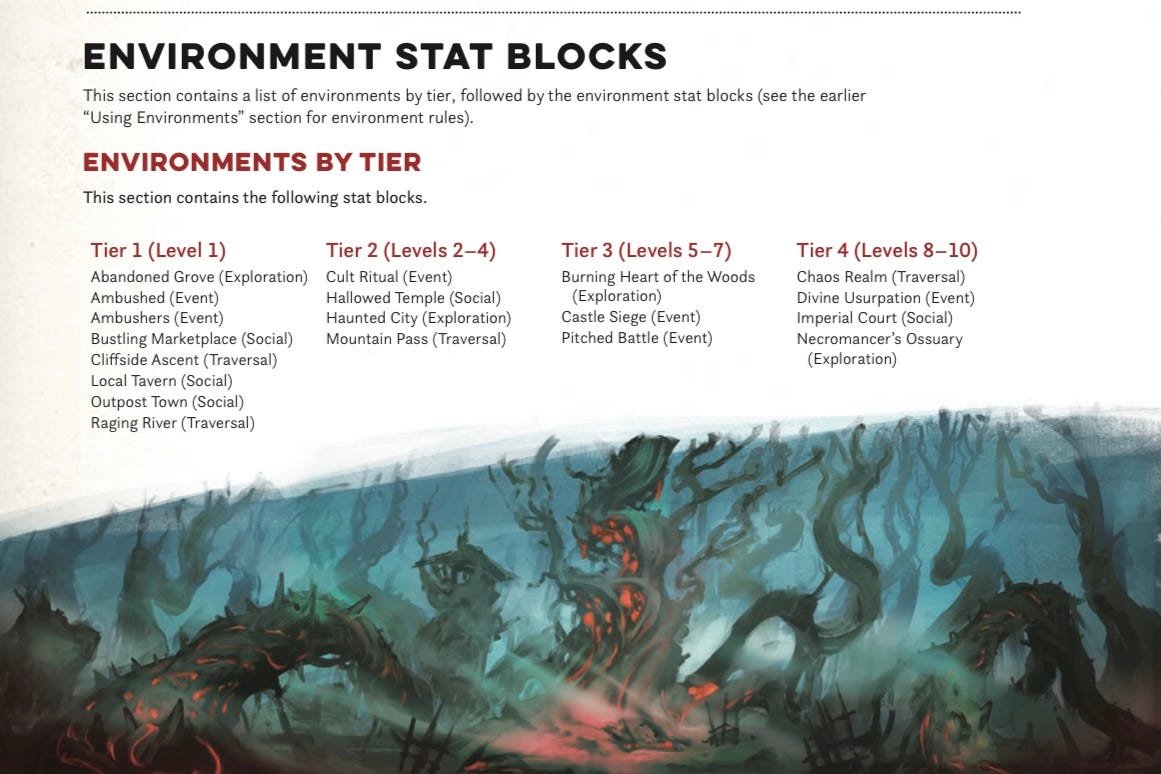
The book offer a variety of them, and you are supposed to learn
• how to use them
• how to tweak them.
First is simple, second is even more simple, but more important.
HOW DO I USE AN ENVIRONMENT?
You can
• improvise a situation based on the current area
• prep a set of premade ones depending on your setting
• pick a couple they’ll likely visit and improvise what’s around them
Whatever the choice, staying faithful to their role is key for a successful Daggerheart session: not only it will grant a solid sense of consistency, but it will give you, the GM, a mean to actually PLAY the game.
Let’s take a look at this:
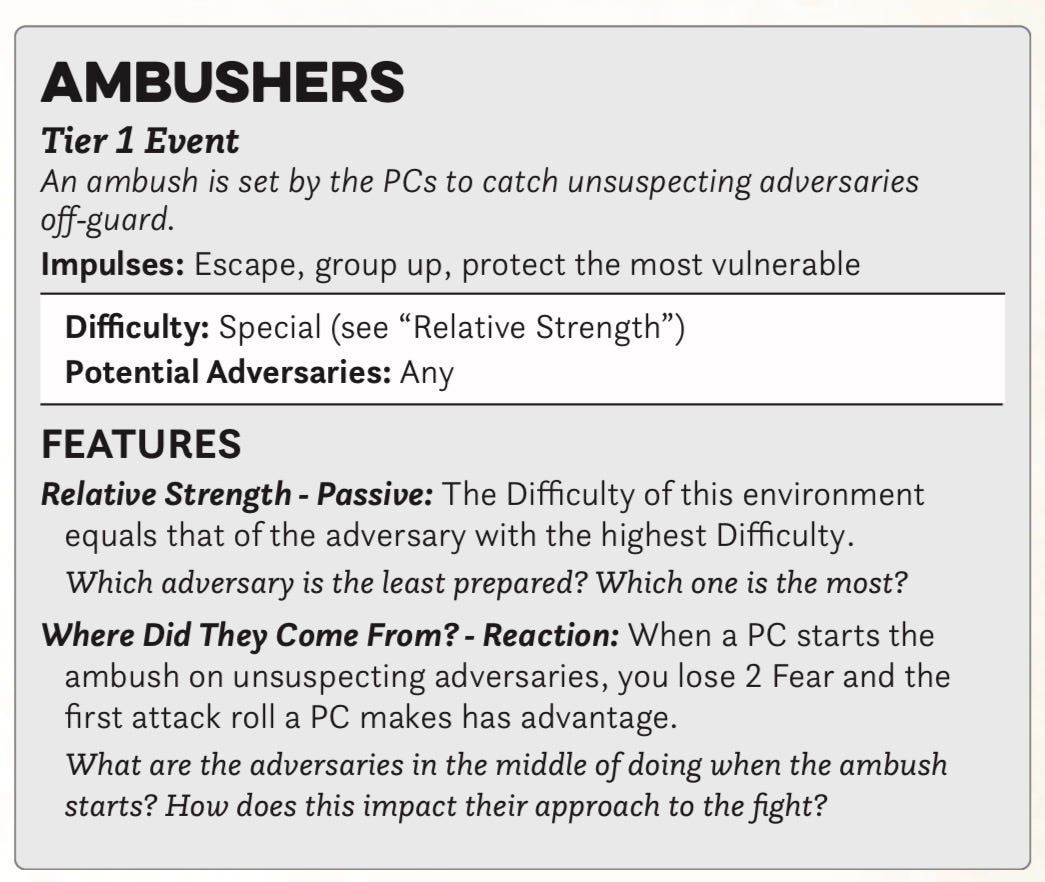
This very simple Environmnt has a lot to tell and it’s obviously very flexible.
It’s an Event (its type) and gives you a narrative line pluse impulses, important guidelines about the why and the how you’ll want to portray.
Most importantly, this is for the Players! Right: you have a simple framework to help the players roleplay and enact the ambush!
You can remove Fear from the GM pool by paying attention to the ambush and you’ll get rewarded for proper planning!
Following it, we find this one:
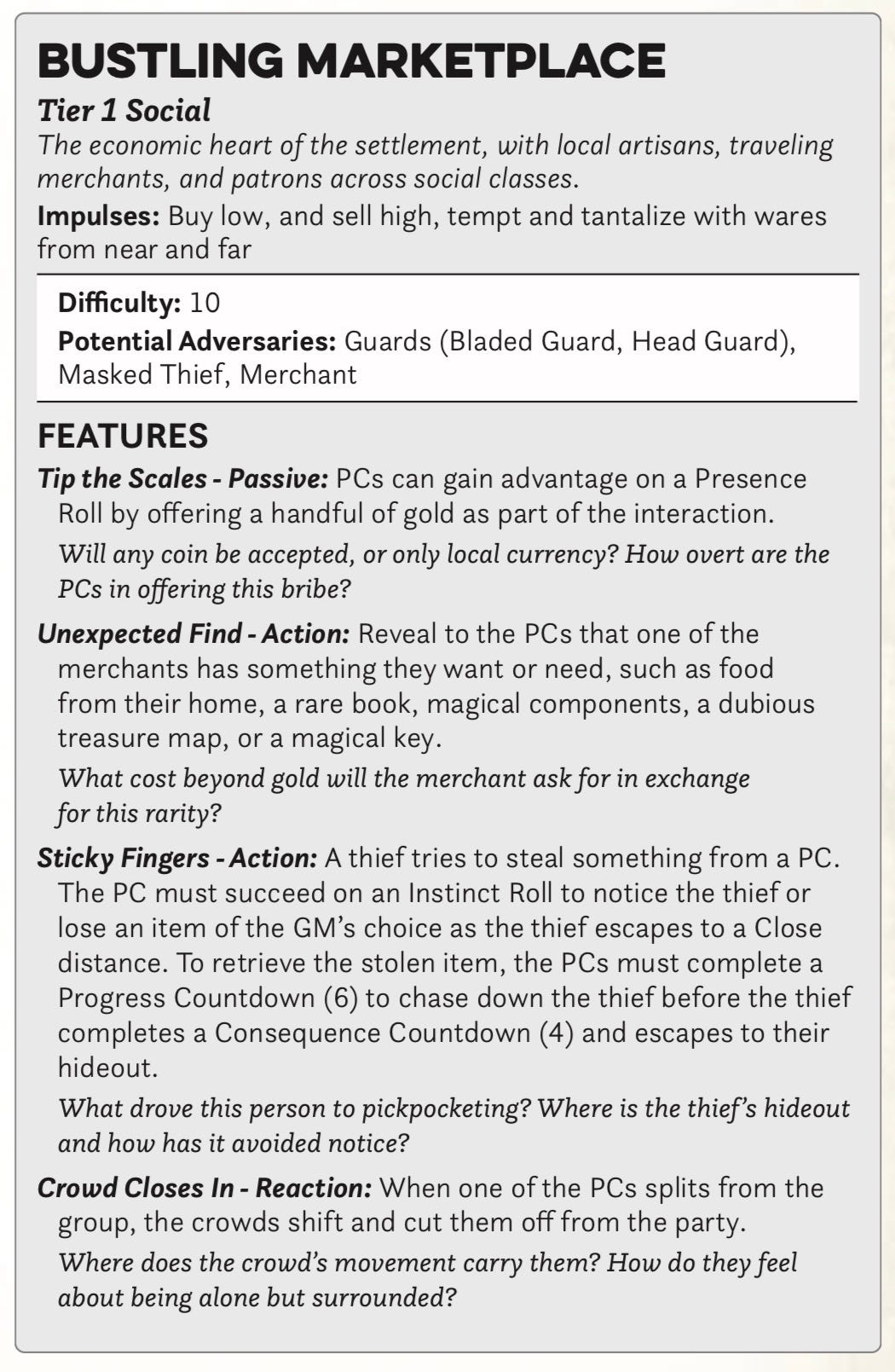
You see more features but it’s not anywheee harder to play. This is a Social type environment:
• the bustling place where our party can be dangerously split (see Crows Closes In)
• the right moment for a thief to steal something important (see Sticky Fingers)
• an important story or personal prompt to jump straight into the past of a character (see Unexpected Find).
You can see this, right? This is not a weird and convulted sub game like fronts and mandatory prep in other games; this is a solid, easy, quick to hack, highly recommended way to adjust your mindset.
After a game or two, you’ll find yourself with far less unspent Fear, and most importantly, you’ll see how the group will get more involved while interacting with the world.
TWISTS: CREATE AN ENVIRONMENT
You can get a lot out of environments and I’ll show this in a sec.
Think about a sci-fi setting, where you are exploring an abandoned ark ship.
You, the GM, will create an appropriate environment. Focus on the themes
• abandoned
• unstable
• survivors
• refilling / safe points
• aliens lurking
Describe it to YOURSELF in a sentence.
Now
• add impulses: hunger, survival, fear and escapism. Focus on whatever you feel appropriate and look HERE when you need a prompt.
• Features. We have them: let’s make them simple
👉 Abandoned and Unstable (Passive) - the ship is crackling and going on its own. After any violent act or event takes place, you can spend 1 Fear to immediately cause all characters to be knocked down and restrained.
👉 Survivors (Passive) - there are 4 survivors (write their names and jobs). Place 4 tokens on this card. As the players discover a new zone, grant them clues about what they see. Any player can remove 1 Token to make an Instinct action roll. They can ask a question about traces, signs of passage or similar evidence; rolling with Fear will give info plus an additional lead towards a Lurking Alien (see below). A crit means the token is not expended.
👉 Lurking Aliens - Feature - Choose a Solo Alien plus one minion group, a skilled and a bruiser. If the party moves in dangerous ground, is knocked out or restrained, a character is vulnerable or if they follow a lead from the Survivors feature, spend 1 Fear to ambush the party and spotlight 1d6 non Leader enemies or the Solo (it gains Relentless 2 if it doesn’t have already).
As long as there is an enemy nearby, whenever the GM would gain Fear, they can force a character to mark a Stress instead of gaining Fear.
👉 Save Point - Feature: after character defeat a group of aliens or discover the place a survivor is hiding, each player can spend 2 Hope to perform a short rest move and unmark 1 stress. If the place is really safe and the players have two or more survivors with them, they can do this for free.
Ok, this was improvised and absolutely weird, but that’s basically it.
• I wrote it in 5 minutes so you can too
• it was plenty of fun
• it’s giving you a framework to work on, a way to spend fear and a way to make it harder by avoiding Fear gains
• it makes it about the survivors and the atmosphere.
• it gives the players an objective and a sense of reward.
You are always granted clues and leads, but you might end up trapped in an ambush while looking for a survivor.
You could add more or change some features. Examples might be
• Bullet hell - Feature: whenever you miss with a fire weapon attack, the GM can spend 1 Fear to describe how the structure is getting damaged (start a Countdown at 4: when it ends, the walls break and gravity or other environmental effects drarcialky change).
• Xeno-Poison - Passive: when a character takes severe damage, they must mark Stress as the poisoning gas is making them weaker.
And more…
As I’ve shown in my previous article, it’s pretty easy to miss Daggerhearts’ key features, especially if you approach the game as “another game”.
It’s not as esoteric as people likes to show, but it has its peculiarities and it would be a waste to just sit down and forget how it doesn’t have any initiate because it doesn’t have any encounter system; or how much Experiences and reskins can impact gameplay…
Or how much Environments will just make your games feel, look and play out better.
They are theme, purpose, gaming, fun interactions, consistency.
Keep playing and build Environments
TSM